

Published
Feb 26, 2026
How to Enter a New Market Without Building New Infrastructure
Learn how direct injection and owned infrastructure are removing the barriers to international expansion for growth-stage ecommerce brands.
Growth Strategies

Published
Feb 26, 2026
How to Enter a New Market Without Building New Infrastructure
Learn how direct injection and owned infrastructure are removing the barriers to international expansion for growth-stage ecommerce brands.
Growth Strategies
Expanding into a new international market can feel like a significant operational undertaking. Warehouses to find, local carrier contracts to negotiate, compliance requirements to navigate, and new partnerships to manage. All before you've shipped a single parcel to your first customer in that market.
For many brands, this complexity is exactly what delays the decision to expand, even when the commercial opportunity is obvious. But the assumption that market entry requires infrastructure investment is one worth questioning. With the right shipping partner and model, it doesn't have to.
What Owned Infrastructure at the Carrier Level Actually Means
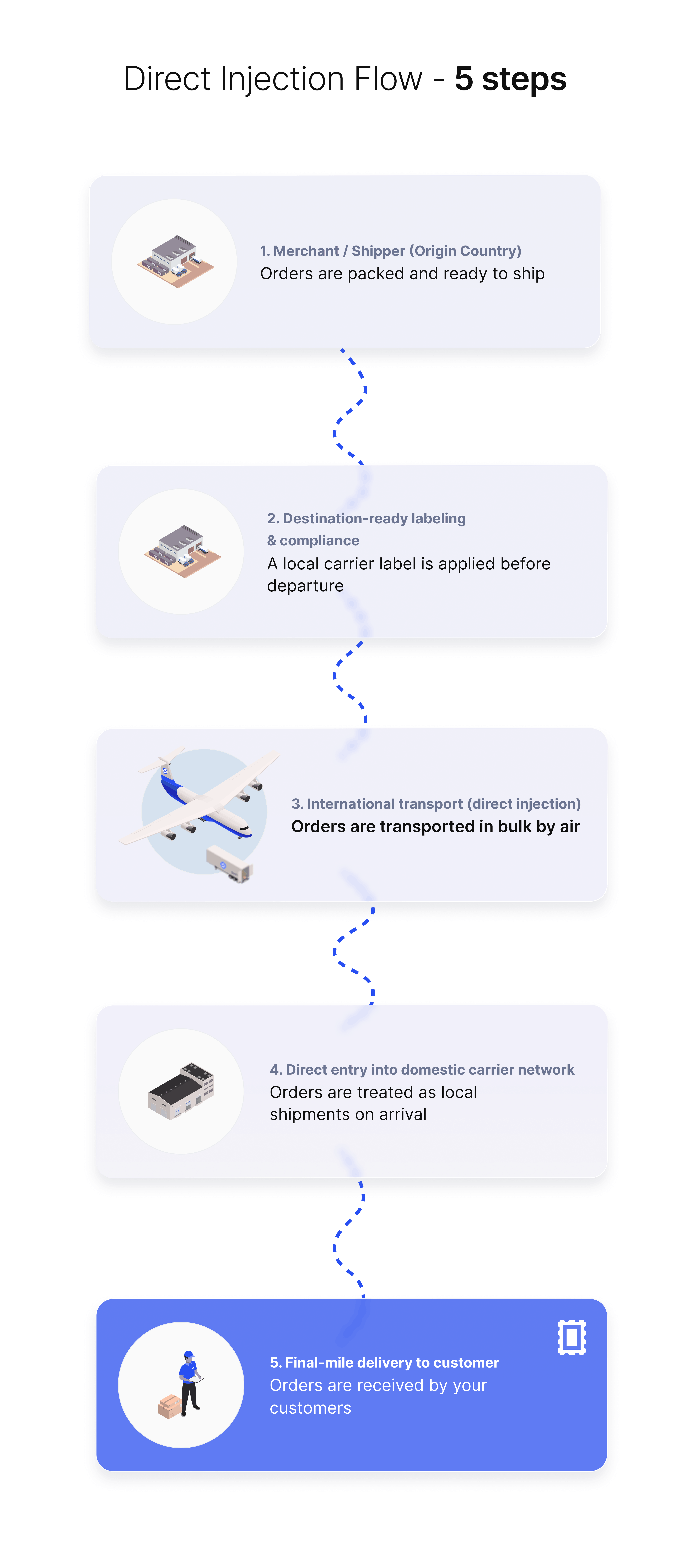
When people talk about "direct injection," they're describing a cross-border shipping model where parcels are consolidated at origin, transported in bulk by air, and injected directly into the destination country's domestic carrier network, bypassing the traditional international express system and its many handoffs.
The key word there is directly. But how direct the experience actually is depends entirely on who controls the network behind it.
When a carrier owns the critical stages of that chain, including dedicated tradelanes, gateway operations and uplift schedules, the journey becomes predictable in a way that aggregated or brokered models simply can't replicate. Controlled origin processing means parcels move on a known schedule. Direct bulk air transport removes the uncertainty of borrowed capacity. Structured handover into trusted domestic carriers at destination ensures the final mile is handled by established local networks.
It's worth noting that even in an owned infrastructure model, final-mile delivery is handled by domestic carriers. That's by design. The advantage is that every step before that handover is controlled, visible, and accountable. That's what removes the unpredictability that makes entering a new market feel risky.
What This Opens Up for Scaling Brands
The traditional case against early international expansion usually comes down to two things: cost and complexity. Owned infrastructure at the carrier level addresses both.
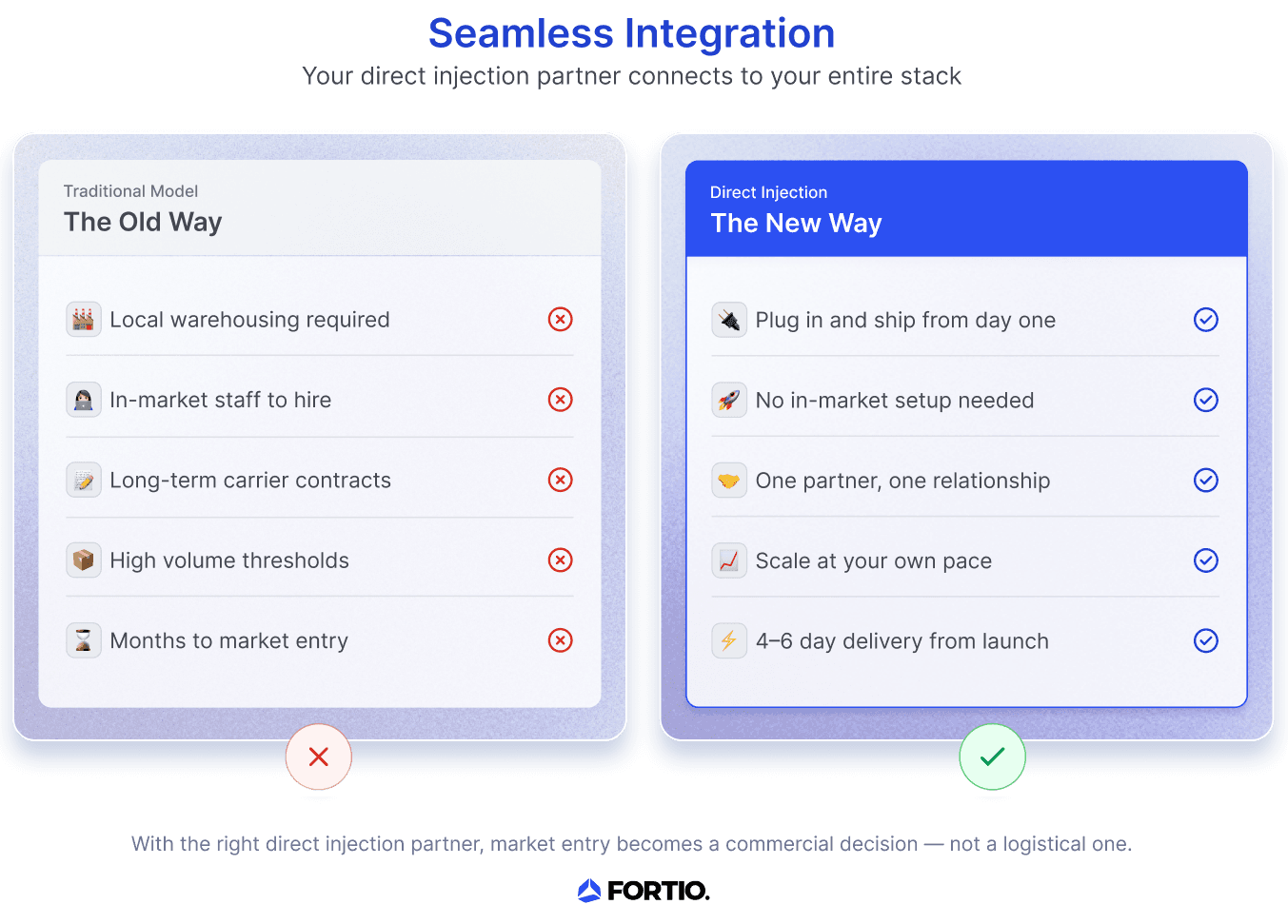
Without the need to establish local warehousing, hire in-market staff, or commit to long-term carrier contracts, brands can test new markets quickly and with limited downside. If a market performs, you scale into it. If it doesn't, you haven't over-committed.
Delivery performance also changes meaningfully. With dedicated tradelanes and controlled linehaul, delivery windows of 4–6 days into key markets (Australia, New Zealand, the UK, the US) become achievable without enterprise-level parcel volumes. That matters for the customer experience: faster, more predictable delivery means stronger customer promises, fewer "where is my order" enquiries, and lower post-purchase support overhead.
Perhaps most importantly, it shifts how expansion decisions get made. When the operational barrier is removed, entering a new market becomes a commercial question rather than a logistical one. That's a meaningful change for growth-stage brands trying to move quickly.
The Role of Technology in Making It Work
Owned infrastructure is only half the picture. Without the right technology sitting on top of it, even a well-controlled network becomes a black box the moment a parcel leaves your hands.
What good looks like in practice
Unified tracking across the full journey, from uplift through to final-mile delivery, with consistent event data regardless of which domestic carrier handles the last leg.
Intelligent routing that uses consolidated volumes and lane data to move parcels through the fastest available pathways.
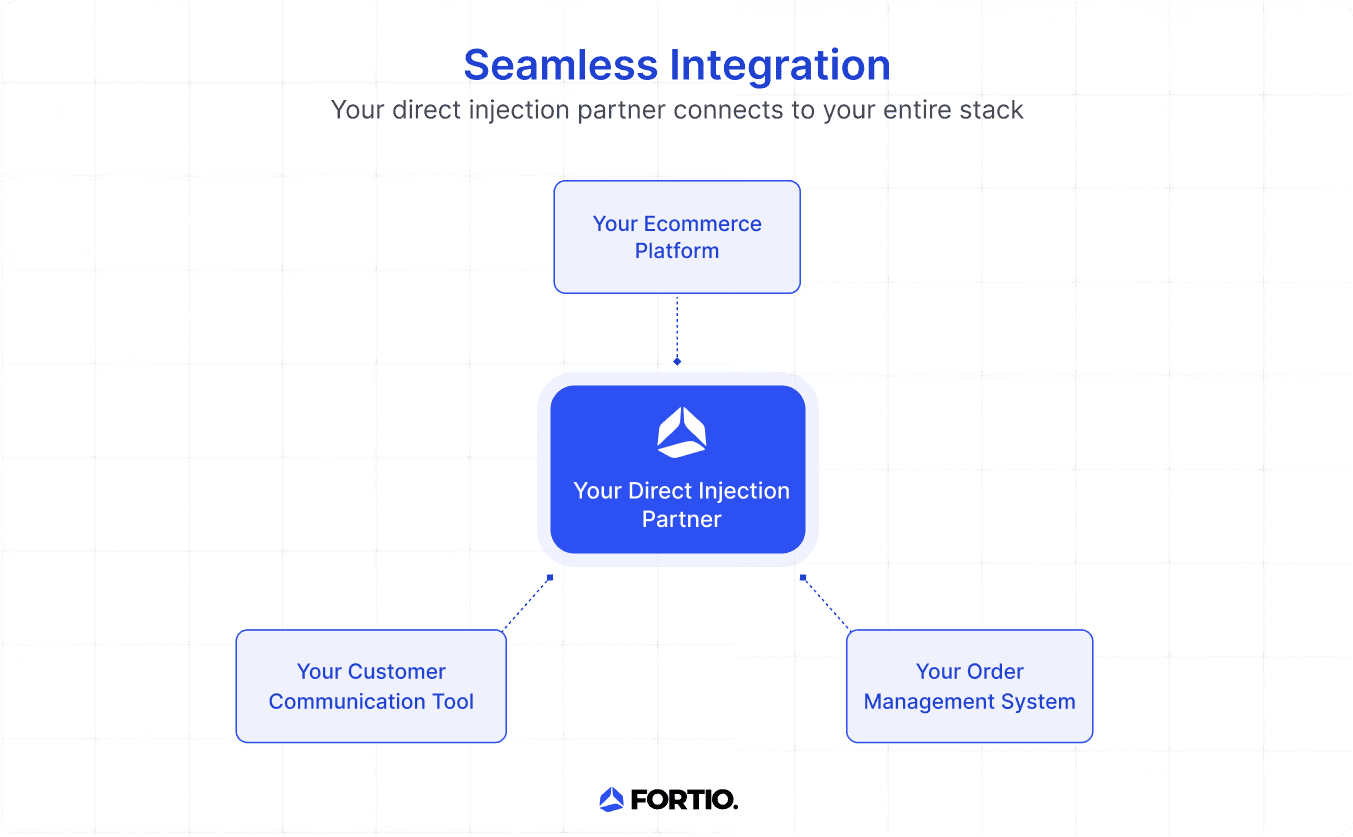
A platform that integrates cleanly with the tools your team already uses, including your ecommerce platform, your order management system, and your customer communications stack.
The integration point is one that often gets underestimated. Poor connectivity between your shipping partner and your existing tools creates friction that compounds at scale: manual workarounds, reconciling data across multiple portals, delayed exception management. These aren't just operational annoyances. They represent real time and cost that erodes the efficiency gains direct injection is supposed to deliver.
Infrastructure and technology need to work together. One without the other still creates friction, just at a different stage of the journey.
What to Look for in a Global Shipping Partner
If you're evaluating direct injection providers, the questions worth asking go beyond price and transit times:
Does the carrier own or control the key stages of the linehaul? There's a meaningful difference between a carrier that operates its own tradelanes and gateway infrastructure, and one that's reselling capacity from third parties. The former gives you a single accountable partner; the latter reintroduces the handoff risks you're trying to avoid.
Is tracking consistent across all markets and carrier handovers? Visibility shouldn't disappear at the point of domestic injection. Look for a provider that offers end-to-end tracking with reliable event data, not just origin-side updates.
How does it integrate with your existing tools? The best partners offer clean API connectivity or native integrations that don't require significant development overhead on your side.
Can it grow with you? Volume thresholds that restrict access to direct injection are a structural limitation of many providers. A partner built for scaling brands should be able to support your current volumes and accommodate growth without renegotiating the relationship.
Is pricing transparent? Fragmented provider networks often introduce hidden costs through multiple intermediaries. Predictable, all-in pricing is a signal that the network behind it is well-controlled.
Expanding into a new international market can feel like a significant operational undertaking. Warehouses to find, local carrier contracts to negotiate, compliance requirements to navigate, and new partnerships to manage. All before you've shipped a single parcel to your first customer in that market.
For many brands, this complexity is exactly what delays the decision to expand, even when the commercial opportunity is obvious. But the assumption that market entry requires infrastructure investment is one worth questioning. With the right shipping partner and model, it doesn't have to.
What Owned Infrastructure at the Carrier Level Actually Means
When people talk about "direct injection," they're describing a cross-border shipping model where parcels are consolidated at origin, transported in bulk by air, and injected directly into the destination country's domestic carrier network, bypassing the traditional international express system and its many handoffs.
The key word there is directly. But how direct the experience actually is depends entirely on who controls the network behind it.
When a carrier owns the critical stages of that chain, including dedicated tradelanes, gateway operations and uplift schedules, the journey becomes predictable in a way that aggregated or brokered models simply can't replicate. Controlled origin processing means parcels move on a known schedule. Direct bulk air transport removes the uncertainty of borrowed capacity. Structured handover into trusted domestic carriers at destination ensures the final mile is handled by established local networks.
It's worth noting that even in an owned infrastructure model, final-mile delivery is handled by domestic carriers. That's by design. The advantage is that every step before that handover is controlled, visible, and accountable. That's what removes the unpredictability that makes entering a new market feel risky.
What This Opens Up for Scaling Brands
The traditional case against early international expansion usually comes down to two things: cost and complexity. Owned infrastructure at the carrier level addresses both.
Without the need to establish local warehousing, hire in-market staff, or commit to long-term carrier contracts, brands can test new markets quickly and with limited downside. If a market performs, you scale into it. If it doesn't, you haven't over-committed.
Delivery performance also changes meaningfully. With dedicated tradelanes and controlled linehaul, delivery windows of 4–6 days into key markets (Australia, New Zealand, the UK, the US) become achievable without enterprise-level parcel volumes. That matters for the customer experience: faster, more predictable delivery means stronger customer promises, fewer "where is my order" enquiries, and lower post-purchase support overhead.
Perhaps most importantly, it shifts how expansion decisions get made. When the operational barrier is removed, entering a new market becomes a commercial question rather than a logistical one. That's a meaningful change for growth-stage brands trying to move quickly.
The Role of Technology in Making It Work
Owned infrastructure is only half the picture. Without the right technology sitting on top of it, even a well-controlled network becomes a black box the moment a parcel leaves your hands.
What good looks like in practice
Unified tracking across the full journey, from uplift through to final-mile delivery, with consistent event data regardless of which domestic carrier handles the last leg.
Intelligent routing that uses consolidated volumes and lane data to move parcels through the fastest available pathways.
A platform that integrates cleanly with the tools your team already uses, including your ecommerce platform, your order management system, and your customer communications stack.
The integration point is one that often gets underestimated. Poor connectivity between your shipping partner and your existing tools creates friction that compounds at scale: manual workarounds, reconciling data across multiple portals, delayed exception management. These aren't just operational annoyances. They represent real time and cost that erodes the efficiency gains direct injection is supposed to deliver.
Infrastructure and technology need to work together. One without the other still creates friction, just at a different stage of the journey.
What to Look for in a Global Shipping Partner
If you're evaluating direct injection providers, the questions worth asking go beyond price and transit times:
Does the carrier own or control the key stages of the linehaul? There's a meaningful difference between a carrier that operates its own tradelanes and gateway infrastructure, and one that's reselling capacity from third parties. The former gives you a single accountable partner; the latter reintroduces the handoff risks you're trying to avoid.
Is tracking consistent across all markets and carrier handovers? Visibility shouldn't disappear at the point of domestic injection. Look for a provider that offers end-to-end tracking with reliable event data, not just origin-side updates.
How does it integrate with your existing tools? The best partners offer clean API connectivity or native integrations that don't require significant development overhead on your side.
Can it grow with you? Volume thresholds that restrict access to direct injection are a structural limitation of many providers. A partner built for scaling brands should be able to support your current volumes and accommodate growth without renegotiating the relationship.
Is pricing transparent? Fragmented provider networks often introduce hidden costs through multiple intermediaries. Predictable, all-in pricing is a signal that the network behind it is well-controlled.
Conclusion
Conclusion
Expansion Is a Growth Decision, Not a Logistics One
The brands scaling fastest globally aren't necessarily the ones with the most complex logistics operations. They're the ones who found a partner that removed the infrastructure barrier and let them focus on the commercial opportunity.
International expansion should be driven by where your customers are and where the growth is, not by how much operational complexity you can manage. With the right direct injection partner, it can be.
If you're looking for a global direct injection partner with owned infrastructure to support your next market, we'd love to talk. Get in touch with the Fortio team.
Expansion Is a Growth Decision, Not a Logistics One
The brands scaling fastest globally aren't necessarily the ones with the most complex logistics operations. They're the ones who found a partner that removed the infrastructure barrier and let them focus on the commercial opportunity.
International expansion should be driven by where your customers are and where the growth is, not by how much operational complexity you can manage. With the right direct injection partner, it can be.
If you're looking for a global direct injection partner with owned infrastructure to support your next market, we'd love to talk. Get in touch with the Fortio team.
Grow globally today
Grow globally today
Whether you’re an enterprise business or you’ve just started to think about expanding, we’re here to help so you can focus on what matters most.
Whether you’re an enterprise business or you’ve just started to think about expanding, we’re here to help so you can focus on what matters most.
Support
Accredited Cargo Agent
Support
Accredited Cargo Agent
Support
Accredited Cargo Agent